

At Kyoku, we understand that true culinary creativity demands the right tools for the right task. Just as a Samurai never went into battle without the correct blade, a chef must select the knife that aligns with the food and the desired cut.
While our Santoku knife is the beloved all-purpose workhorse—the utility katana of the kitchen—there are times when you need the specialized power of a Boning Knife or the sheer might of a Butcher Knife.
Let’s break down the distinct roles of these three essential knives, allowing you to approach your prep work with the precision and effectiveness of a master craftsman.
The Three Pillars of Cutting: A Quick Comparison
These three knives are not interchangeable. They are designed for completely different actions, profiles, and materials.
| Knife | Primary Purpose | Blade Profile & Key Feature | Typical Cutting Motion | Ideal For… |
| Santoku | All-Purpose Precision | Wide blade, flat-to-sheep’s-foot tip (no piercing point), often with a Granton edge. | Quick, vertical Push-Cutting and slicing. | Vegetables, mincing herbs, slicing boneless meat/fish. |
| Boning | Meat Fabrication | Narrow, slim blade with a sharp, piercing tip. Can be stiff, semi-flexible, or flexible. | Precise, curvilinear cuts around bone and connective tissue. | Separating poultry joints, deboning fish, trimming silver skin. |
| Butcher (Cimeter) | Breaking Down Carcasses | Long, heavily curved blade, thick spine, pointed tip. Heavier and more robust. | Long, sweeping Slicing and leverage for tough, large cuts. | Breaking down large primal cuts of beef/pork, trimming fat/gristle. |
1. The Santoku: The Generalist’s Grace
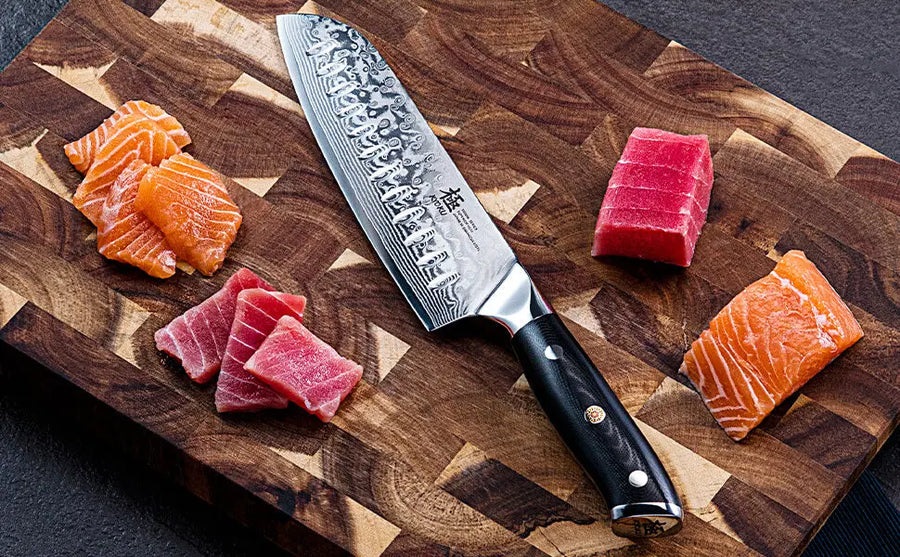
As the Japanese take on the Western Chef’s Knife, the Kyoku Santoku is built for speed, balance, and precision on the cutting board.
-
Design Philosophy: The name means “three virtues” (slicing, dicing, mincing). It embodies the Japanese principle of elegant efficiency in preparing ingredients.
-
The Blade: Features a shorter, straighter edge than a traditional Western knife. Our Kyoku high-carbon steel is honed to an exquisite edge, making it glide through vegetables and boneless proteins. The lack of a sharp tip (the “sheep’s foot”) emphasizes safety and its role in a chopping-only capacity.
-
When to Reach for It: For 90% of your daily kitchen work. Chopping onions, dicing carrots, slicing thin cucumber ribbons, or mincing garlic. If the food item doesn’t have a bone, the Santoku is your best choice for rapid, clean cuts.
2. The Boning Knife: The Surgeon of the Kitchen
The Boning Knife is a highly specialized tool designed for one critical, precise job: separating muscle from bone and navigating the contours of a carcass.
-
Design Philosophy: To be maneuverable and to follow the bone structure with minimal meat waste.
-
The Blade: This is its most distinguishing feature. It is narrow and thin to easily fit into tight spaces. Crucially, it has a sharp, pointed tip for piercing the skin and initiating cuts near joints.
-
Flexibility Matters: Boning knives come in varying degrees of stiffness. A flexible blade is ideal for poultry or fish, bending to hug the curves of the rib cage. A stiff blade is better for larger, tougher meat like pork or beef.
-
-
When to Reach for It: When fabricating proteins. De-boning a whole chicken, separating meat from the bone of a pork shoulder, or trimming silver skin and fat from a tenderloin. Its narrow profile is perfect for intricate work where a wide Santoku blade would be cumbersome.
3. The Butcher Knife: The Heavy-Duty Powerhouse
Also often called a Cimeter knife (due to its long, curved blade profile), the Butcher Knife is a brute meant for the heavy lifting of raw meat preparation.
-
Design Philosophy: To break down large, tough cuts with authority, using the length of the blade for sweeping, powerful slices.
-
The Blade: Typically long (8 to 12 inches), thick, and heavy. The defining feature is the deep, continuous curve of the blade leading to a strong, pointed tip. This shape maximizes the contact area during a long slice and provides leverage. It is not for fine slicing or vegetable prep.
-
When to Reach for It: If you are buying primal cuts (large sections of meat) and breaking them down into roasts, steaks, or manageable portions. It excels at:
-
Cutting through thick ligaments and cartilage.
-
Trimming large sections of fat and gristle.
-
Creating long, even slices of large, cooked roasts (though a dedicated Slicer is often better for presentation).
-
Your Kyoku Knife Selection Guide
Choosing the right tool isn’t about complexity; it’s about purpose.
-
If your passion is precision preparation—mincing, dicing, and fast-paced vegetable work—the Kyoku Santoku is your primary kitchen companion.
-
If you frequently fabricate poultry, fish, or beef from the bone, a quality Kyoku Boning Knife is an indispensable tool that will reduce waste and save time.
-
If you deal with large, raw cuts of meat and need a heavy-duty blade for processing, the robust Butcher Knife is the specialist you need for leverage and power.
Embrace the legacy of the Samurai with a sharp, balanced knife for every task, and elevate your creative cooking to the next level.